
Sissification: Where Does the Sissy Fantasy Come From?
A man in the role of a sissy doesn't stop being a guy in everyday life - though behind closed bedroom doors he certainly won't be called that. Where does the fantasy of sissification in heterosexual men come from, what is the purpose of a chastity cage, and how to safely set up this scenario?

In a random sample of 2,450 people aged 18-60 in Sweden, 2.8% of men and 0.4% of women reported at least one episode of sexual arousal induced by wearing clothing of the opposite sex. These data were presented by Niklas Långström and Kenneth Zucker in a study published in the Journal of Sex & Marital Therapy in 2005. Sissification does not create a new orientation or identity out of nowhere - it relies on the desires of an adult man who already wants it, transforming them into a specific erotic scene. The elements of this game include feminine attire, a name change, the role of a submissive maid, and often a chastity cage.
The sought-after "transformation into a submissive girl" is therefore an agreement and an element of roleplay, rather than a permanent alteration. Below, we present facts based on scientific research and explain what the terms sissy, sissification, and chastity cage mean in practice.
Where Does the Fantasy of Being a Sissy Come From?
In this context, the word sissy does not describe a permanent character trait or identity, but a specific erotic role. The same man can train at the gym in the morning and desire to be addressed as a good girl in the bedroom at night. The authors of the Merck Manual point out that dressing in women's clothes (crossdressing) occurs among both heterosexual and homosexual men, while it is much less common among women.
The mere fact of wearing clothing attributed to the opposite sex is not a basis for a diagnosis. In the DSM-5-TR classification, transvestic disorder is diagnosed only when arousal related to crossdressing persists for at least six months and causes the individual severe distress or real problems at work, in social relationships, or other important areas of life. Most people for whom crossdressing is a form of expression or a fetish do not meet these criteria. Furthermore, in the ICD-11 classification, transvestic fetishism is no longer treated as a separate medical disorder. Dressing up that does not harm the person or those around them is not considered a disorder.
However, this mechanism can run deeper than just the contents of a wardrobe. In the same medical manual, the term autogynephilia is used to describe arousal triggered by the thought or image of oneself as a woman. Feminine attire then becomes merely a prop. Sometimes, a female name, a partner's appropriate tone of voice, and a ban on using one's own genitalia are enough to achieve satisfaction.
A Specific Fetish or a Trait of Male Psychology?
The second layer of this fantasy turns out to be much more common than crossdressing itself. In 2015, Christian Joyal, Amélie Cossette, and Vanessa Lapierre surveyed a group of 1,516 adult residents of Quebec (including 717 men), asking them about 55 different erotic fantasies. The results of this research were published in the Journal of Sexual Medicine. A fantasy of being sexually dominated was reported by as many as 53.3% of men. Crucially, within the same study group, 89.5% of men identified as heterosexual. It is worth noting that this was an online sample with an average age of 29.6 years (people aged 55 and older accounted for just 10% of respondents) - so it is not a statistical reflection of society as a whole. However, it clearly shows that bedroom submission is not a rarity among men who function as heterosexual individuals in daily life.
When it comes to the attire itself, the statistics require a more cautious interpretation, and this fantasy should not be attributed to the majority. For women, the idea of wearing clothes associated with the opposite sex was statistically unusual: reported by 6.9% of respondents. For men, the same fantasy was reported by 10%. This falls below the 15.9% threshold that the authors use to classify a fantasy as unusual, though they did not include it on the list of atypical male fantasies. The average intensity was higher for men than for women (0.67 versus 0.43). When participants whose favorite fantasy was not listed were asked to describe it in their own words, a transvestic motif appeared in 2.8% of men's responses. There is a difference between having a certain fantasy and placing it at the top of one's list.
Personality structure also does not fit the stereotypical portrait of an "effeminate man". George Brown and his colleagues studied a group of 188 men who practice crossdressing (the study did not involve therapy patients). The findings, published in the Journal of Nervous and Mental Disease in 1996, clearly indicate that in terms of personality traits, these men practically do not differ from the rest of the population. Moreover, the group defined as transvestites (meaning individuals who experience arousal from clothing but have no need to live as a woman) actually showed fewer traits traditionally assigned to the female gender role than men pursuing a permanent social role transition. A fetish and gender identity are two completely different areas.
Studies and Statistical Margin of Error
The previously mentioned Swedish correlates must be interpreted carefully and without drawing overly broad conclusions. Långström and Zucker linked episodes of crossdressing with an ease of reaching arousal, more frequent use of pornography, a higher frequency of masturbation, and other elements of paraphilias (such as arousal from pain, exhibitionism, or voyeurism). This study also revealed a statistical link with same-sex sexual experiences. However, this does not determine a person's sexual orientation. In Joyal's research, 20.6% of men reported fantasies about sex with another man, even though 89.5% of men in that sample identified as heterosexual. A sissy scenario involving a second man is merely a form of bedroom agreement. It does not define the partner's identity or orientation in everyday life.
So where does the motif of coercion come from in this game? It stems from the fact that some men wish to wear women's clothing but do not want to feel responsible for making that choice. The concept of forced feminization sets up the dynamic of the relationship so that the partner takes the initiative: choosing the lingerie, assigning a new name, and locking the chastity cage. In this way, the man completely relinquishes control. However, it is vital to remember a fundamental rule of BDSM - control in bed can only be surrendered through a conscious, adult, and sober agreement made beforehand outside the intimate space.
Sissification and Related Concepts

Sissification therefore proves to be a narrower concept than crossdressing in general, yet broader than the mere use of chastity cages. Wearing feminine clothing without invoking the aesthetic and role of a "sissy" is simply classic crossdressing. On the other hand, a chastity cage used without a female wardrobe is often an element of orgasm denial, a practice we described in more detail in our article on male submission. Sissification successfully combines all these elements into a cohesive, erotic narrative based on the symbolic loss of the traditional male position.
These fantasies should also not be equated with the lives and identities of transgender people. The authors of the Merck Manual explicitly distinguish a situation where arousal from the clothing itself fades over time in favor of a permanent need to live in a female role. A transgender person is not a temporary prop in anyone's bedroom game. If a partner with whom you share intimate moments communicates that womanhood is their true identity, and not just a Saturday night erotic role, this must be respected. In such cases, there is no place for imposing fetishistic, pink nicknames.
Chastity Cage
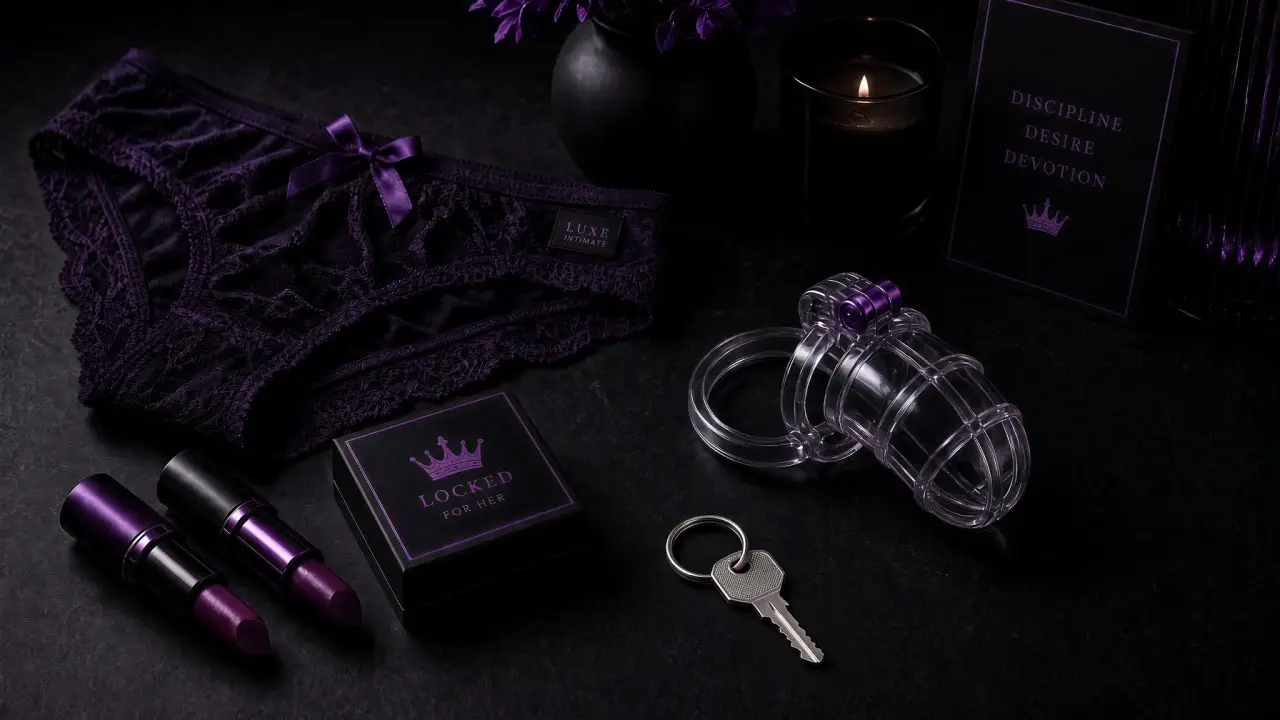
A chastity cage serves one crucial purpose in sissification. The man's anatomy remains unchanged, but his decision-making power over when an erection or orgasm occurs disappears completely. Control over sexual satisfaction is fully handed over to another person, and the cage itself cannot be slipped off secretly under the covers as easily as a partner's hand. The motif of controlling orgasms regularly resurfaces when analyzing general sexual fantasies. For example, in Warsaw, these accessories can be easily found on the shelves of brick-and-mortar stores.
However, a chastity cage is not an innocent piece of jewelry, and its use carries real health responsibilities. In 2026, urologists from Istanbul described the case of a 32-year-old man who, as part of BDSM practices, wore a chastity cage continuously for 48 hours. After removing the device, the patient experienced severe pain, and within the next 6 hours, he arrived at the emergency room with pronounced swelling and an extensive subcutaneous hematoma in the distal part of the penis. Although a Doppler ultrasound showed no loss of cavernosal bodies or fascia, and the patient did not struggle with urethral bleeding or urinary incontinence, the case required conservative treatment.
The symptoms resolved two days after starting therapy, the dressing was removed after a week, and the hematoma reabsorbed completely within 3 weeks. After 6 months of follow-up, the man's sexual functions returned completely to normal. Writing in the Haydarpasa Numune Medical Journal, the authors of this medical report warn that wearing a cage for too long or carelessly can lead to infections, abscesses, tissue necrosis, and later to cavernosal fibrosis and erectile dysfunction. While this is a single case report, it serves as an important warning for every user.
The primary rule of safe fitting is body observation. A ring at the base under which a finger cannot be easily slid is definitely too tight and risks cutting off blood supply. On the other hand, burning or pain during urination means that the tube or shield of the cage is pressing too hard against the urethra. This device should never be forced on. Furthermore, after every removal of the cage, it is essential to thoroughly clean both the skin and the object itself. Any scrape, cut, or skin irritation strictly ends the fun until the tissue has completely and healthily healed.
How to Set Up a Scene When He Already Desires It?
It is impossible to change the preferences of a man who shows no such inclinations. This is a psychologically demanding fetish, much harder to achieve than, for instance, convincing your partner to try swinging. Sissification can only be arranged with a partner who already thinks about it and needs it himself. The authors of the Merck Manual point out a practical aspect of this dynamic: with a supportive partner, men can feel comfortable during intimacy in women's clothing. When the other side is reluctant, anxiety, guilt, and shame arise, followed by a cycle of throwing away women's clothes, buying them all over again, and feeling shame.

Introducing this fetish is best planned step by step, rather than jumping straight into the deep end with a full maid costume:
- Discussion outside the bedroom: The partner should clearly state which words and phrases arouse him (e.g., sissy, a new name, "girl"), and which completely kill the erotic mood. Separately and absolutely, boundaries regarding anal sex, the involvement of third parties, taking photos, or going outside in costume must be discussed.
- One element instead of the whole set: To start, women's lingerie, using a new name, or a lightweight chastity cage (with the man keeping the key himself) is enough. Combining all these elements at once is a scenario from porn movies, not a recipe for a successful first Saturday together.
- Safeword: Just like in any other practice related to BDSM, it is necessary to establish a clear signal to stop the scene. The word "red" immediately ends the roleplay, removes the command of submission, and means the cage must be opened. A safe-word is always established before putting on any props.
- Proper aftercare: After the scene ends, immediately return to the partner's real name and normal tone of voice. Erotic humiliation that drags on into breakfast together is not a healthy way to exit a role and can negatively impact the relationship.
Shopping together or visiting boutiques for women's lingerie is an advanced step. In Warsaw, there are friendly places where clothes can be selected and tried on in larger, male sizes without unnecessary comments. You can find a detailed list of such spots in our text on crossdressing and trans-shopping in Warsaw. It is worth going there only when the partner himself expresses a clear desire to do so.
Sissification and Chastity Cages - Frequently Asked Questions
Does sissification change a man's sexual orientation or gender identity?
No. Sissification is an erotic role and a bedroom scenario, not a permanent identity change. The desire for submission or crossdressing does not make a man a transgender person. We explain the exact difference between a fetish and gender identity in our article why we don't say shemale.
Can a masculine, heterosexual guy want to be a sissy?
Absolutely. In a 2015 study by Joyal, 53.3% of men reported having a fantasy of being sexually dominated, and 89.5% of the men in that sample identified as heterosexual. The Merck Manual adds that crossdressing occurs among both heterosexual and homosexual men.
How long can a chastity cage be safely worn?
Wearing a cage requires caution - cases of complications described in medical literature (such as painful swelling and hematomas) developed in as little as 48 hours. Any numbness, pain, or change in skin color is a signal to remove the device immediately. The emergency key must always be close at hand.
What is forced feminization?
This is a BDSM scenario where a partner takes full control, imposing a female role and props onto the man. However, the word "forced" refers strictly to roleplay - in reality, it requires prior, full, and conscious consent given outside the bedroom.