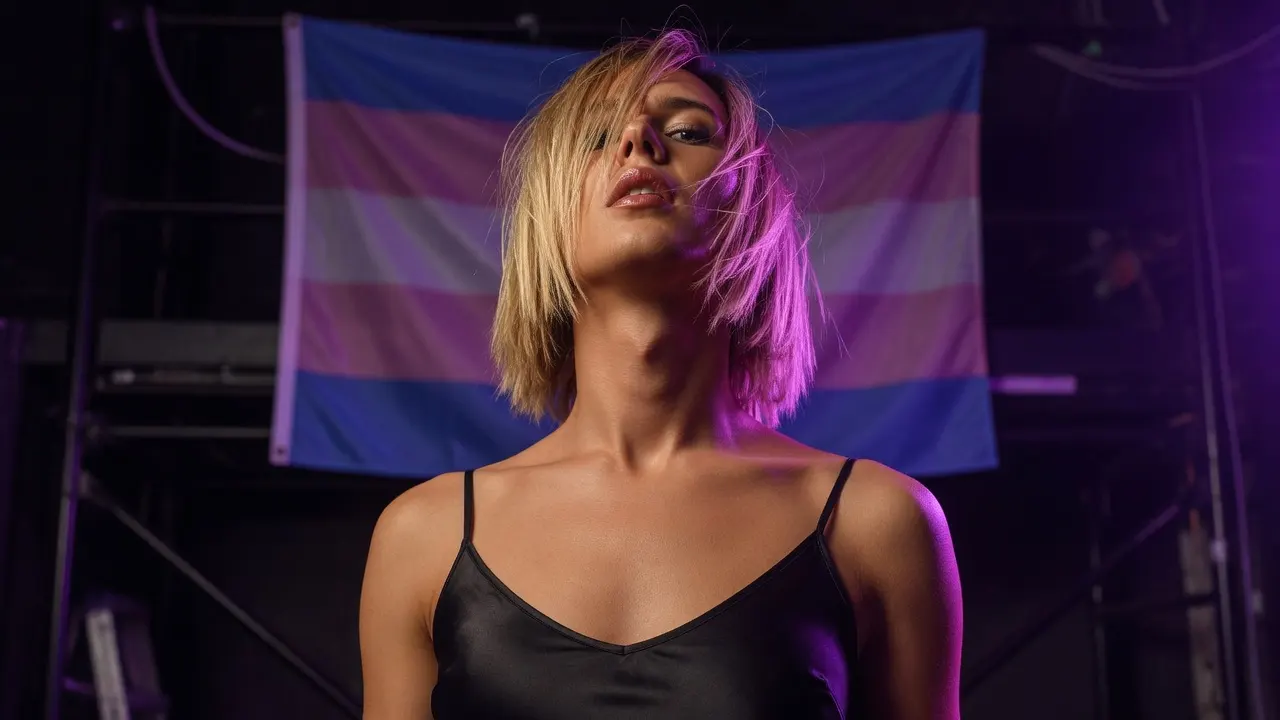
Porn, Shemale, Sex? Female Transsexualism Trapped in Language
About the wild sexual fantasies of heterosexual men from the VHS cassette era and how they have shaped the perception of transsexual women in society. A historical-linguistic take on the exonym.
Language is never neutral toward human sexuality and identity. It often acts as a silent architect of reality - shaping forms, drawing boundaries, and sometimes erecting invisible walls in human perception. In the sphere of intimacy, it is particularly evident how single words can both open space for understanding and confine it within narrow, simplifying frames. Today's reflection concerns precisely these frames - the mechanisms that turn the richness of female transsexualism into a convenient consumer category, packaged in the plastic phrase "shemale".
It is true that some trans women consciously refer to themselves this way and naturally allow others to address them as such. This is their choice, often directly linked to their private sexuality. It may represent a kind of vulgarity fetish, just as cis women sometimes want to be called "whore". Similarly, a trans woman may, according to her preferences, also favor a vulgar term describing her.
In today's text, we will try to break down these walls of imagination and help the reader understand the essence of the problem. The linguistic factor will be broken down into its prime components, and all doubts related to the naming of trans women will be effectively dispelled.
Euphemisms, Exonyms and Mechanisms of Linguistic Power
In linguistics, it has long been known that names given to groups "from the outside" are rarely neutral. American linguist James A. Matisoff, introducing the distinction between autonyms and exonyms in his 1986 work The languages and dialects of Tibeto-Burman, aptly noted:
Human nature being what it is, exonyms are liable to be pejorative rather than complimentary, especially where there is a real or fancied difference in cultural level between the ingroup and the outgroup.
Negative word-formation toward different groups, cultures, or nations is not solely a matter of ill will. It is an anthropological mechanism - the dominant language group creates simplified, often stigmatizing terms for those whose experience goes beyond its cognitive frames. Over time, such words enter common circulation, become "normal", and their original offensiveness fades in the users' consciousness. The exonym ceases to be perceived as an external label - it begins to function as an allegedly objective description.
It is worth distinguishing between a euphemism and an exonym. A euphemism softens reality to make it more palatable ("to pass away" instead of "to die"). An exonym, on the other hand, often serves a function of ordering the world according to the logic of the dominant group - it simplifies, reduces, and not infrequently deprecates. Both phenomena, however, meet at one point: language is never merely a tool of description. It is a tool of symbolic power.
From "Eskimo" to "Inuit": A Lesson That Cannot Be Ignored
A classic example of an exonym that functioned for decades as a "neutral" name and was later rejected by the group itself is the term "Eskimo". Although long used in scientific and popular literature, this term does not originate from the languages of the Arctic peoples. Its etymology remains disputed - most likely derived from the Innu (Montagnais) language, originally meaning "the one who ties snowshoes". The folk etymology linking it to "eater of raw meat" has been discredited, yet it was precisely this that reinforced negative connotations for years.
For many Inuit, Yupik, and Aleut people, the word "Eskimo" became a symbol of the colonial gaze - an external, simplifying label imposed by outsiders. In 1977, the Inuit Circumpolar Council officially adopted the name "Inuit" as the common term for the peoples inhabiting the circumpolar regions. In 2010, the council issued a resolution calling on the world of science and institutions to abandon the terms "Eskimo" and "paleo-Eskimo" in favor of "Inuit" and "Paleo-Inuit".
The 2010 Inuit Circumpolar Council Resolution clearly shows that even deeply rooted terms in language can - and should - change when the group they concern finds them offensive. This process is not instantaneous. Exonyms become part of the cultural heritage of the dominant language, and resistance to abandoning them can be strong. Yet change is possible when respect for self-determination outweighs the comfort of habit.
This example provides an excellent reference point for phenomena observed in a completely different sphere - the world of sex and pornography.
"Shemale" - The Birth of a Commercial Exonym

Unlike "Eskimo", which grew out of colonial contact, the term "shemale" (or "she-male") is a much more conscious and deliberate creation. It emerged in the pornography industry of the late 1980s and 1990s as a marketing tool. It combined the pronoun "she" (female presentation) with "male" (biological male genitalia), creating a category designed to sell content to heterosexual men without triggering homophobic defense mechanisms.
Many users in Poland come across this type of content precisely through the phrase "shemale porno" - both in the search engine and in the deeper layer of their consciousness. As sex columnist Regina Lynn aptly put it in her 2007 Wired column:
Porn marketers use 'she-male' for a very specific purpose - to sell porn to straight guys without triggering their homophobia - that has nothing to do with actual transgendered people (or helping men overcome their homophobia, either).
Melissa Hope Ditmore, an expert on the rights of sex workers, in her Encyclopedia of Prostitution and Sex Work emphasizes that the term:
...is an invention of the sex industry, and most transwomen find the term abhorrent.
Biologist Joan Roughgarden, author of Evolution's Rainbow, rejected the use of this term even in scientific literature, considering it:
...is an invention of the sex industry, and most transwomen find the term abhorrent.
Joan Roughgarden's Evolution's Rainbow (University of California Press) and numerous analyses of the porn industry show one common denominator - "shemale" did not arise as an identity name. It was created as a commodity category, emphasizing the discrepancy between presentation and biology - precisely the element that constituted the commercial appeal in pornography.
The Linguistic Trap of Female Transsexualism

The problem with "shemale" is not only its derogatory power. It lies in the fact that this term actively deforms the way female transsexual identity is perceived. Instead of conveying the internal coherence of the experience - identity, body, history, desires - it reduces them to one sensational feature. A person becomes a "mixture", a "surprise", a "special category".
In this way, the language of pornography does not describe reality - it constructs it for the needs of consumption. Just like former ethnic exonyms, "shemale" imposes an external perspective in which the identity of a trans woman exists primarily as an object of fascination or fetish, rather than as a full-fledged, autonomous subjectivity.
People searching for female transsexualism in internet space often encounter precisely this language - a language that leaves no room for nuances, authentic narrative, or respect for self-determination. As a result, many trans women feel excluded from the mainstream dating scene. The constant reminders in categories created by pornography only reinforce this. Not to mention the social pressure associated with transphobia.
A Gentle Breeze of Social and Linguistic Changes
The dominance of the popular term, shaped by erotic fantasies of Poles and other nationalities, has left a strong mark. However, it is not an irremovable flaw. Analyses of movement in the Polish internet reveal a growing social desire to gain substantive knowledge.
More and more people in Poland are typing into search engines phrases aimed at explaining why shemale is offensive, or indicating the real source of the problem, such as "shemale or trans woman - the difference". Importantly, the contemporary pornography industry is partially moving away from this term - replacing it with the more natural formulation "trans". This change, however, stems mainly from economic and image pressure, rather than deep reflection on linguistic mechanisms. In everyday circulation, "shemale" still functions as a convenient, yet simultaneously harmful label.
A Language of Respect as an Alternative to Consumer Categories
Against this background, the need for a different, higher-quality language stands out particularly clearly - a language that does not reduce, but opens up. In our earlier text on writing a good profile description on Wink3r, we emphasized how important it is for words to reflect real experience rather than impose ready-made templates. The same applies to identity terms.
Authenticity requires the courage to abandon convenient but hurtful labels. It requires a willingness to listen to how a given person names herself and how she wants to be perceived. It requires understanding that female transsexualism is not a pornographic category, but a spectrum of living, complex experiences - just as diverse as the experiences of any other group.
It is no coincidence that in our articles we repeatedly emphasize the boundary of good taste in interpersonal contacts and that sexual freedom does not mean a lack of responsibility for words. The same principle applies in the context of identity language. Freedom does not consist in thoughtlessly repeating categories that bring harm to someone else. It consists in the conscious choice of words that respect the dignity of the other person.
At Wink3r, we believe that the dating space can - and should - be a place where language serves to build a unique connection between two people, rather than categorization. People looking for how to meet a transsexual woman can build authentic connections here without imposed labels. It is a place where trans woman simply means a woman whose history includes the transsexual experience - without additional sensational adjectives. Where authenticity is not a marketing slogan, but everyday practice.
Toward a Language That Does Not Imprison
The history of "Eskimo" teaches that even deeply rooted terms can disappear when the group they concern gains a voice and respect. The history of "shemale" shows that some terms should never have been created - because from the beginning they served not a reliable description, but growing sales figures.
When searching for dates with trans people in Poland, one should pay attention to both the linguistic layer and the form of expression. This is particularly important if we use methods such as clear coding. Unfortunately, in a moment of temporary excitement, it is very easy to forget about hurtful verbal frames.
Female transsexualism deserves a language that is not a trap. A language that does not emphasize discrepancy for effect, but allows for full, multidimensional existence. A language in which she does not require quotation marks or an explanation in parentheses.
If this text struck a chord with you - if you are wondering how your own words influence how you perceive others - leave a comment below. We would be happy to hear your reflections. And if you are looking for a space where authenticity and respect are not empty phrases, join Wink3r. Here we are building a community where everyone can be themselves - without imposed categories, without pornographic filters, with full respect for who they really are.
Because true connection begins where the language of traps ends.